How to Choose Artificial Topiary Shapes and Heights for Garden Centers
Introduction
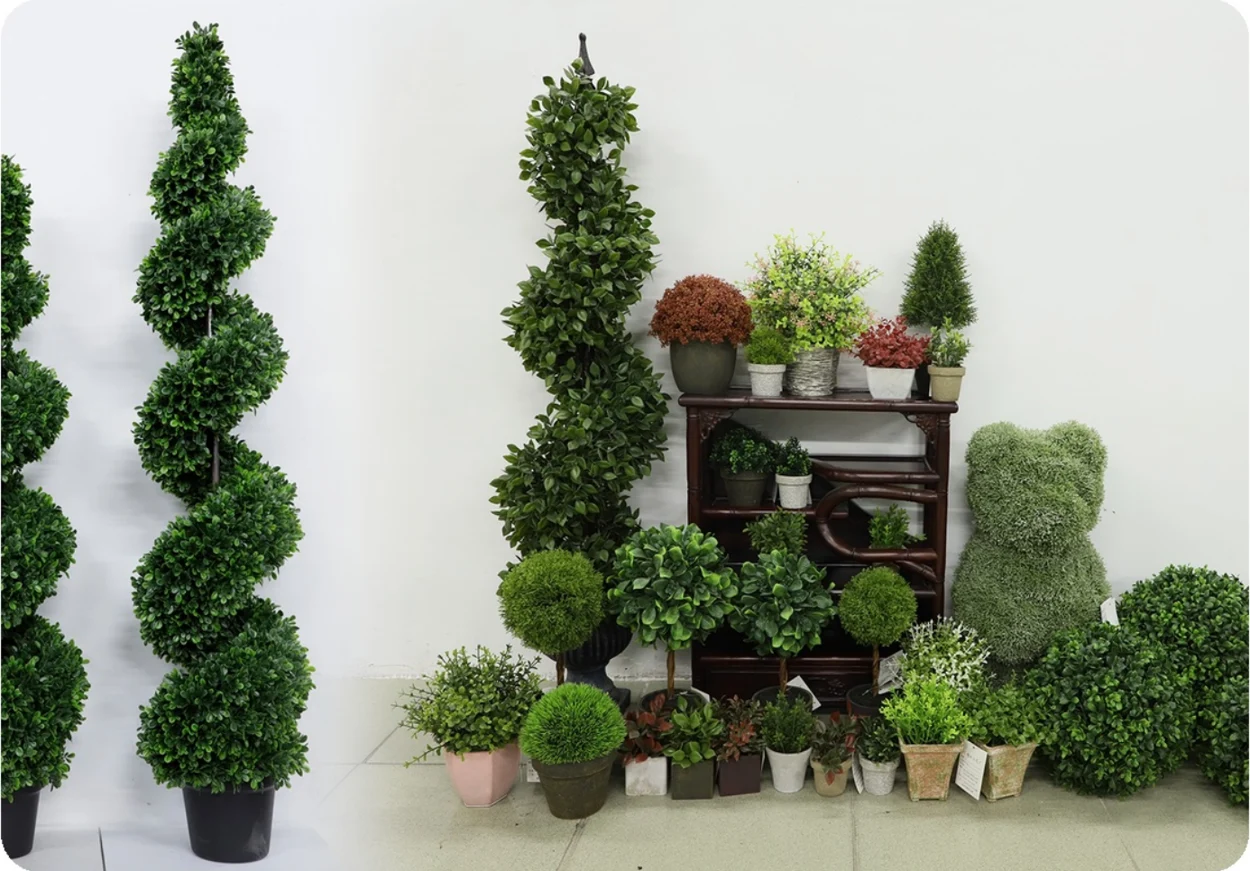
Choose artificial topiary by working backward from the display location. Record the available height and width, the usable planter footprint and the direction from which shoppers will approach. Then compare silhouettes at their finished dimensions. A cone can provide height beside an entrance, a ball can define a low display, and a spiral can give a shopper a reason to look at a feature from more than one angle. Those advantages depend on the actual width and base of the model being ordered.
This guide is for garden centers, importers and commercial buyers who need to shortlist models for several display positions. It also covers how to check a sample and build a range that a receiving team can unpack, set up and replenish. The catalog examples identify real SanBao models and listed heights. The placement examples are hypothetical and use buyer-defined measurements.
Start with three dimensions and two viewing positions
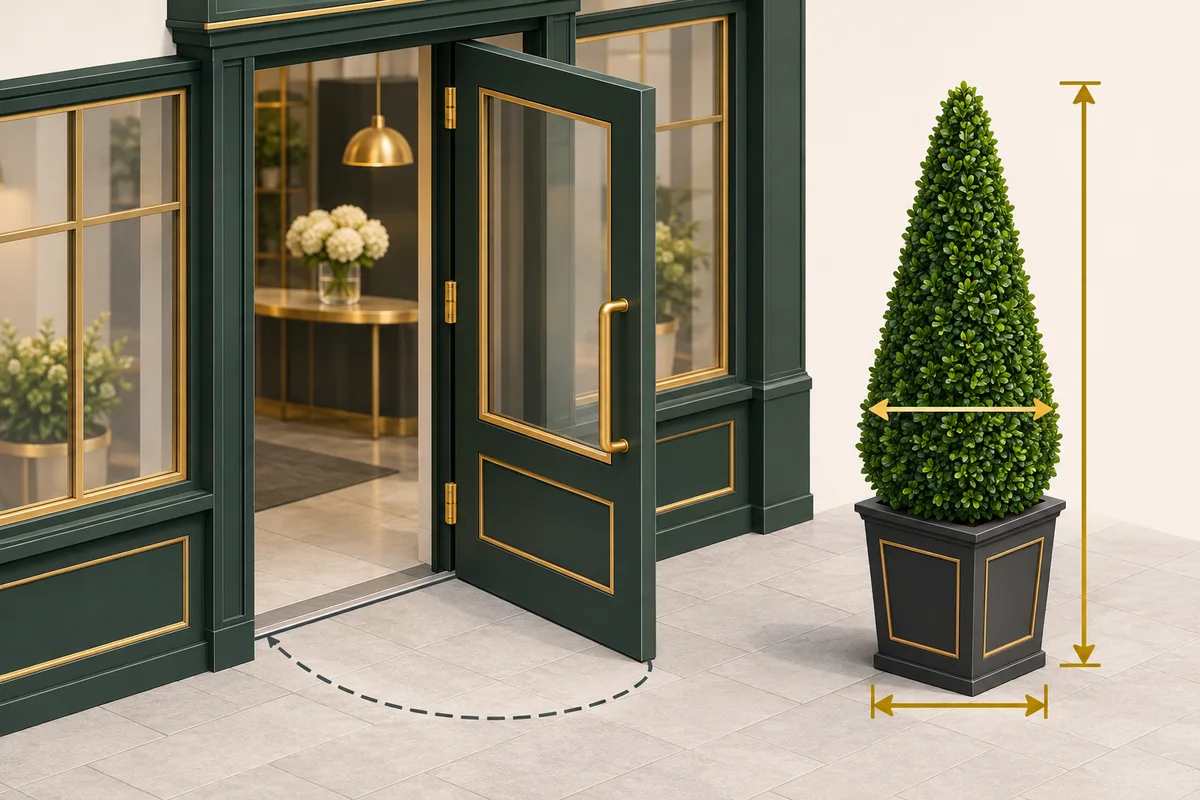
Measure the space where the product will actually stand. At an entrance, the distance between the wall and a door frame can be much greater than the space available after allowing for the door swing, a display plinth and customer movement. For a raised display, record the platform height separately. A plant with a finished height of 120 cm becomes a different visual proposition when it sits on a 40 cm platform.
Write down the maximum finished height, maximum foliage width and maximum base footprint. Ask the supplier whether the listed height includes the pot and whether width refers to the foliage after shaping. Record the pot's top width and the dimensions of the base that contacts the floor if it has a tapered profile. A decorative outer planter adds its own dimensions. Verify both its internal fit around the supplied pot and its external footprint on the site.
Then check the display from two positions. Stand where a shopper first sees it and again where someone reaches for the adjacent merchandise. A tall plant can help a display read from the end of an aisle while obscuring a label at arm's length. Take a photo from each position, with a tape measure or familiar fixture in the frame. This gives the supplier a better starting point than a photograph of the empty space alone.
Define the use before comparing products
| Display location | Shape to shortlist | Measurement that often changes the decision |
|---|---|---|
| Paired store entrance | Cone, tower or spiral | Door swing and width at the widest foliage point |
| Low aisle feature | Ball or compact potted greenery | Total height including any platform |
| Display visible from several directions | Spiral or multi-ball | Width from front and side after shaping |
| Seasonal promotional area | Animal-shaped topiary | Silhouette visibility from the approach and room for surrounding stock |
| Commercial lobby or reception | Tall cone or layered multi-ball | Floor footprint, sightlines and access for installation |
Treat the table as a shortlist. Site teams should determine the usable display envelope and any required access or circulation clearances before a model is approved.
Compare ball, cone, spiral and multi-ball topiary
Ball topiary for low, repeatable displays
A ball gives a display a clear outline from several directions. It can work beside signs, on low platforms or as a repeated element along a row of fixtures. If the primary display job is to keep a view open, compare the entire unit height, including any visible stem and outer planter. A raised ball on a stem can occupy the same sightline as a small tower, even when the foliage diameter looks modest in a catalog.
Compare the height of the foliage above the floor across units intended for the same row. When the pots are placed side by side, differences in stem exposure or ball position can be easier to see than they were during separate sample reviews. Ask for paired photographs if the sales presentation depends on consistent height and form.
Cone and tower topiary for vertical displays
Cones and towers are useful candidates when the display needs to read vertically. A narrower profile may suit a tight entrance, but confirm the width at the base of the foliage as well as the planter dimensions. Two towers listed at the same height can have different proportions, and the wider of the two can take up the space needed by signage or merchandising.
SanBao lists the T4M-004B tower at 120 cm and 150 cm. Those options give buyers two heights to discuss under the same model code. For an entrance pair, specify one height for both units unless you deliberately want an asymmetrical display. Ask for a photo showing the selected height and planter together. SanBao wholesale catalog
Spiral topiary for displays that reward a second look
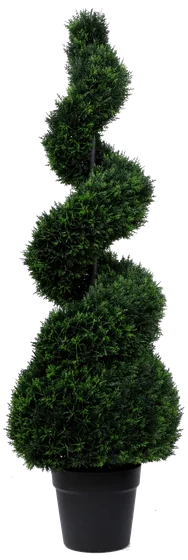
The open spaces between turns are part of the spiral's design. A photograph taken from one angle can hide an area where foliage is thin or a curve is hard to read. Request a front view and a quarter-turn view. If the plant will be visible from both sides of an aisle, include a rear view in the sample review.
SanBao's SBY-008 is listed at 120 cm and 152 cm. Compare the finished silhouette against nearby shelf heights or signs. A taller plant may make the turns visible from farther away, while the shorter option may leave a better view of merchandise behind the display. Confirm how the plant is packed and whether staff will need to shape the foliage after unpacking. SanBao wholesale catalog
Multi-ball and animal shapes for featured assortments
Multi-ball forms can bridge a low ball display and a taller entrance pair. Look for lateral branch spread at the height where customers reach for goods. Ask for the foliage outline in plan view, or have the supplier show the widest span in a photo with a ruler. SanBao lists the Q4M-026 multi-ball model at 81 cm. It can serve as a reference when comparing layered forms with taller vertical models. SanBao wholesale catalog
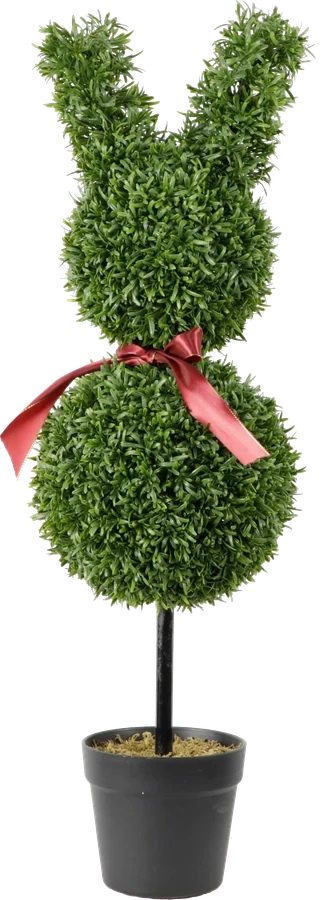
Animal-shaped greenery works when the silhouette tells the shopper what the display is about from a distance. A rabbit may suit a spring feature, but ears or a head can disappear against shelving of a similar color. Test the intended backdrop and viewing angle with the sample. For instance, SanBao's RSJC-001 rabbit is listed at 100 cm. Ask how projecting features are supported in the carton, especially if the units will be stored and reused seasonally. SanBao wholesale catalog
Work through a display before requesting a quote
Suppose a garden center has a covered entrance with two display positions, each with a buyer-measured envelope of 55 cm wide by 45 cm deep. Those figures are the space the shop has allocated after checking circulation and the door swing. The shop wants a tall, matched pair, visible through the entrance glazing, and a lower grouping farther inside. Start by asking for the overall width, base dimensions and full height of both tower options. Confirm whether the outer display container is part of the order or will be supplied locally.
The tallest shortlisted model may sit well within the height limit and still fail the footprint check. If a supplier confirms a finished spread of 47 cm for a particular sample, a 55 cm position leaves 8 cm across the width before allowing for irregular edges or position changes. The 47 cm figure here is an example, not a SanBao dimension. Staff should mark the real outline on the floor and check it with the door open. If the plant fits but the planned outer planter does not, the mounting arrangement still needs revision.
Inside the store, compare the ball and multi-ball candidates at their planned display heights. Put one sample next to the products it will support. If it hides the price ticket or makes the display hard to reach, move the plant to an end position or choose a lower model. Take a photograph at normal viewing distance so the buying team can compare this setup with the intended planogram later.
Send your display dimensions
Share a site photo, the maximum finished width and height, and the shapes you are considering. Include whether the area is indoors, covered or exposed so the factory can review the correct configuration. Send Your Requirements
Use the sample to check how the product will be handled
Ask for a sample in the proposed pot, foliage and size. Photograph it before and after unpacking. Follow the supplied shaping instructions, record any tools required and note the time your own team needs to set it up. If staff will need to assemble the product or insert it into a decorative planter, have them perform that step with the expected materials. Compare the result with the reference photo and agree on the finish the bulk order should match.
Agree on what a matched pair looks like
For a paired display, place samples on the same level floor. Compare the heights at the foliage tip, inspect the pot positions, and look at both plants against the same background in consistent light. Check the shape from both directions customers will use. A small variation in individual branches may be acceptable when the overall outlines read as a pair. If your installation requires stricter alignment, record that criterion with the supplier before the order is placed.
Check receiving, setup and storage
Ask the supplier for carton dimensions and gross weight for the exact configuration. Compare the packed dimensions with receiving doors and storage shelves. A product may fit the finished display while the carton proves difficult to move through the stockroom. If cartons are likely to be opened at a distribution center, confirm whether each unit still has a label that identifies its model and size after the outer carton is discarded.
For seasonal products, agree on how staff will return the unit to storage. Ask whether shaping can be repeated and which projecting parts need protection. When the product will be reordered later, retain the approved model code, finish and planter specification alongside the display photos. The guide to wholesale samples, MOQ and cartons covers the buying documents for that next step.
Build a first assortment you can replenish
Give each model a defined job. One tall pair can anchor an entrance, a lower ball style can support several displays, and a seasonal feature can carry a short promotion. Add another height when it solves a clear placement problem or lets stores use the same visual theme at different scales. Separate every height by order line, even if the supplier uses the same base model code.
SanBao’s wholesale MOQ is one 20-foot container per order. If you need to combine different shapes, planters or sizes, send your proposed mix for review. Plan replenishment by the quantities each branch actually uses and check how the revised assortment can be packed for the next order.
For several branches, build a simple branch allocation. List how many units each entrance, display table and seasonal zone requires. Separate display stock from units intended for sale and decide whether replacements will be held centrally or at each shop. If one model needs to serve several sites, confirm the measurements of the tightest location before committing it to the entire rollout. A single well-checked configuration can simplify both receiving and product replacement.
Prepare the location before delivery
Identify who is responsible for receiving, moving, unpacking and approving placement. Confirm that the base is suitable for the surface. For placements exposed to weather, send photographs of the site and ask for written use conditions and installation guidance for the specific model. A foliage UV report cannot establish whether a planter and assembled unit are suitable for a windy position. For public or exposed sites, have the responsible site team review the installation arrangement.
Create a handover sheet with the approved product photo, model and size, planter choice, setup instructions and display location. Note any shaping required after unpacking and what staff should do if a unit arrives with a bent stem or damaged planter. Include the order reference so receiving can match photographs and carton labels to the correct shipment. This is especially useful when the same purchase order includes several closely related sizes.
FAQ
What height should artificial topiary be at a shop entrance?
Choose height after measuring the clearance, base space and first viewing position. Compare the finished height, foliage width and outer planter together. A 120 cm and a 150 cm model can both work in different entrances, depending on the available space and where you want the eye to land.
What is the difference between a cone and a spiral topiary?
A cone reads as a continuous tapered outline. A spiral has visible turns and gaps, so its appearance changes more with viewing angle. Compare finished width and pot dimensions for both. Ask for more than one view when the spiral will be seen from several directions.
Should I buy a pair from the same model and height?
Specify the same model, height and planter for a coordinated pair, then agree how closely the silhouettes and finished heights should match. Use the approved sample or a clear pair photo to make the expected appearance easier to communicate.
Can I place an artificial topiary in a planter I buy separately?
Ask for the supplied pot's top and bottom dimensions and compare them with the opening and internal space of the decorative planter. Also check how the inner pot will be supported and whether the added container changes the overall footprint or handling requirements.
How do I check an artificial topiary for outdoor use?
Describe the actual exposure and request use conditions and any relevant documentation for the exact configuration. Review foliage weathering, planter and frame suitability, and site stability separately. A covered display can still receive angled sun, wind or rain.
Conclusion
The easiest topiary range to buy is one with a defined job for every shape, measured spaces for every display and a sample that receiving staff can set up. Compare the finished plant and planter together, document the features that should match across the order, and keep the item codes with your display plan. Those records make quoting, approval and replenishment easier.
Get a quote for your topiary assortment
Send SanBao your display measurements, preferred models or reference photos, quantities and destination. If several stores will use the same assortment, include the tightest display position and any differences in packing or labeling. Angebot anfordern